
Environmental Donation Impact Finder
Not sure where to send your money? Answer three quick questions to find an organization that aligns with your values and maximizes your impact.
You’ve decided to help the planet. That’s great news for the ice caps and the bees. But then you hit a wall. There are hundreds of environmental organizations out there, all asking for your money, time, or attention. How do you pick one? Do you go with the giant that everyone knows, or the small local group planting trees in your neighborhood? The truth is, there is no single "best" organization for everyone. It depends entirely on what problem keeps you up at night and how you want your donation to work.
Choosing where to send your cash is actually a strategic decision. You are buying impact. If you give £50 to a massive global NGO, it might fund a fraction of a policy paper. If you give that same £50 to a local river cleanup crew, you might physically remove ten kilos of plastic from a stream near your house. Both matter, but they feel very different. This guide breaks down the major players, helps you figure out your priorities, and gives you a checklist so you don’t get swindled by a catchy logo.
Define Your Impact Style
Before you look at any charity website, ask yourself this: do you want to change laws, save specific animals, or clean up local spaces? Most donors fall into one of three camps. Knowing which one you are saves you from donating to an organization whose mission doesn’t actually excite you.
- The Policy Shaper: You believe big change happens when governments sign treaties or companies change supply chains. You’re okay with indirect results. You care about carbon pricing, deforestation bans, and ocean plastics legislation.
- The Species Guardian: You have a soft spot for pandas, whales, or rainforests. You want to know exactly who or what you are saving. Direct conservation feels more tangible to you than abstract policy shifts.
- The Local Fixer: You live in Edinburgh (or anywhere else) and you see litter in your park. You want to see the trees you planted. You prefer high transparency and low overhead costs because you trust neighbors more than boardrooms.
If you are a Policy Shaper, huge international NGOs are usually your best bet. They have the lawyers and lobbyists to move mountains. If you are a Local Fixer, skip the giants. Find a community trust. And if you are a Species Guardian, look for organizations with strong scientific backing rather than just marketing departments.
The Big Three Global Giants
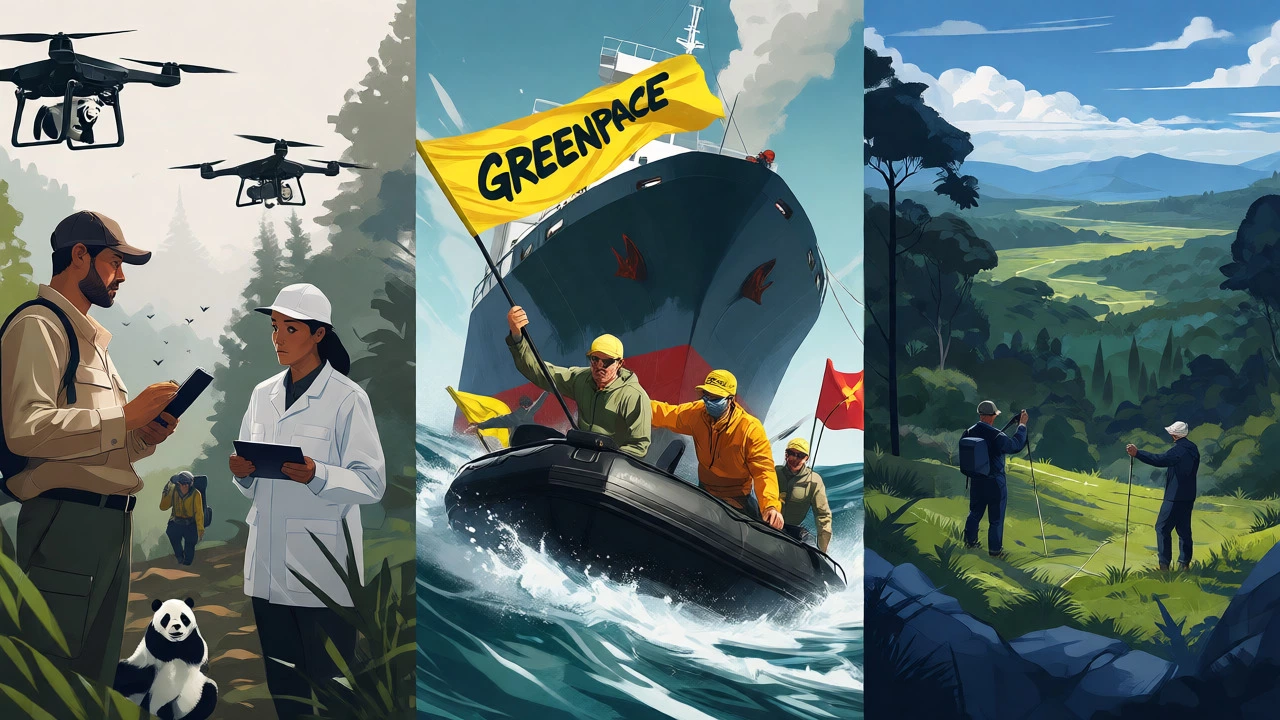
When people think of environmental charities, three names usually pop up: WWF, Greenpeace, and The Nature Conservancy. Each has a distinct personality and operational model. Understanding these differences prevents you from donating to the wrong vibe.
The World Wide Fund for Nature (WWF) is the panda-logo giant. Founded in 1961, it operates in over 100 countries. WWF focuses heavily on species preservation and habitat protection. They work closely with governments and businesses. Critics sometimes argue they are too cozy with corporations, partnering with brands like Coca-Cola to reduce water usage. Supporters say this pragmatism gets real-world results faster than protest alone. If you want stability and broad reach, WWF is a safe, albeit expensive, choice.
Greenpeace is the activist rebel. They don’t accept government funding, relying solely on individual donations. This independence allows them to be loud and confrontational. They target specific campaigns-like stopping deep-sea mining or fighting fast fashion. Their strength is public pressure. If you want your money to fund direct action and media stunts that force companies to react, Greenpeace is the fit. Just know that their overheads can be higher due to global campaigning infrastructure.
The Nature Conservancy (TNC) is the scientist’s favorite. They buy land. Literally. TNC protects nearly 125 million acres worldwide by purchasing property or creating easements. They use data-driven approaches to preserve biodiversity hotspots. They are less flashy than Greenpeace but highly effective at long-term ecological security. If you prefer engineering solutions and land banking over protests, TNC aligns with your values.
| Organization | Primary Strategy | Funding Model | Best For... |
|---|---|---|---|
| WWF | Conservation & Partnerships | Donations, Gov Grants, Corporate | Broad impact, species focus |
| Greenpeace | Direct Action & Advocacy | Individual Donors Only | Political pressure, visibility |
| TNC | Land Purchase & Science | Donations, Investments, Gov | Long-term habitat security |
Hidden Gems: Effective Altruism Picks
If you hate the idea of your money going to fancy offices in London or New York, look at Effective Altruism recommendations. This movement uses data to find charities that save the most lives or protect the most carbon per dollar spent. They often highlight smaller, lesser-known organizations that punch above their weight.
For climate change specifically, GiveWell recommends the Clean Air Task Force (CATF). CATF lobbies for specific technologies like carbon capture and methane regulations. They aren’t famous, but their advocacy has influenced US energy policy significantly. Another standout is the ClimateWorks Foundation, which funds a network of regional climate groups. By pooling resources, they amplify local voices without bloating administrative costs.
Why choose these? Transparency. These orgs publish detailed cost-per-ton-of-carbon-avoided metrics. You can see exactly what your £10 buys. Compare that to a general donation to a large NGO where the breakdown is vague. If you are a numbers person, start here.
Local Action Matters More Than You Think
We tend to ignore local groups because they lack Instagram followers. But in Scotland, for instance, local trusts are doing critical work. Groups like the Scottish Wildlife Trust manage nature reserves right on your doorstep. When you donate locally, you see the results. You walk past the rewilded bog you helped fund. You join a volunteer day and meet the other donors.
Local organizations also have incredibly low overheads. Often run by volunteers, nearly 100% of your donation goes to the cause. No jet-setting executives. No multi-million pound headquarters. Just shovels, saplings, and science. Plus, supporting local biodiversity helps pollinators that affect your garden. It creates a feedback loop of community engagement and ecological health.
Check your council website for registered environmental trusts. Look for those with clear annual reports showing land acreage protected or hectares restored. Avoid groups that only exist online with no physical presence unless they are coordinating remote efforts.

The Due Diligence Checklist
Before you hit "Donate," spend five minutes checking the facts. Scams exist, and inefficiency is common. Use this quick audit to ensure your money lands well.
- Check the Overhead Ratio: Aim for at least 75% of funds going directly to programs. Sites like Charity Navigator (US) or the OSCR register (Scotland) list financial details. If admin costs exceed 25%, ask why.
- Read the Annual Report: Skip the glossy photos. Look for the "Impact" section. Does it list specific outcomes? E.g., "Planted 10,000 mangroves" vs. "Helped communities." Specificity signals honesty.
- Verify Registration: Ensure they are a registered charity. In the UK, check the Charity Commission or OSCR database. Unregistered groups might not offer Gift Aid, costing you 25% of your donation’s value.
- Look for Red Flags: Beware of organizations that refuse to answer questions about leadership salaries. Also, watch out for "matching gift" scams that pressure you to give immediately via phone.
One pro tip: Check if the organization accepts stock or crypto donations. Large NGOs often have dedicated teams for this, maximizing the tax efficiency of larger gifts. Small locals might not, so factor that into your giving strategy.
How to Decide Based on Your Values
Still stuck? Here is a simple decision tree. If you want to fight climate change globally and trust data, support CATF or similar EA-recommended orgs. If you want to stop plastic pollution and enjoy activism, choose Greenpeace. If you love animals and want stable, long-term projects, WWF is solid. If you want to see your impact in your own city, donate to your local wildlife trust or river cleanup crew.
Remember, consistency beats size. A monthly £10 donation to a small local group often provides more stable funding than a one-off £100 gift to a giant. Recurring donations allow organizations to plan ahead. They hire staff, buy equipment, and commit to multi-year projects. So, pick a cause you can stick with, even if it’s modest.
Finally, don’t underestimate the power of volunteering. Money is great, but time is rarer. Many environmental groups desperately need weekend warriors to plant trees or monitor bird counts. Volunteering also lets you vet the organization firsthand. You’ll quickly learn if they are efficient or chaotic. Try it before you give.
Which environmental charity has the lowest overhead?
Generally, small local conservation trusts have the lowest overheads, often under 10%, because they rely on volunteers. Among large NGOs, The Nature Conservancy typically maintains a high program-to-admin ratio compared to some advocacy-focused groups like Greenpeace, which may have higher fundraising and campaign costs.
Is it better to donate to local or global environmental causes?
It depends on your goal. Global causes address systemic issues like climate change and biodiversity loss, which require international cooperation. Local causes provide immediate, visible benefits and strengthen community resilience. Ideally, split your budget: 70% to global/high-leverage causes and 30% to local actions that keep you connected to the issue.
Do corporate partnerships dilute the mission of environmental NGOs?
Critics argue yes, suggesting NGOs become too soft on polluters to keep sponsorship deals. Proponents argue that engaging corporations drives systemic change faster than boycotts alone. Look at the specific partnership terms; if an NGO retains editorial independence and pushes strict standards, the partnership can be beneficial. If they merely slap logos on products, it’s likely greenwashing.
How does Gift Aid increase my donation value in the UK?
If you pay UK income tax, Gift Aid allows charities to reclaim the basic rate of tax on your donation. This increases the value of every £1 you give by 25p. So, a £40 donation becomes worth £50 to the charity. Always tick the Gift Aid box if eligible, as it costs you nothing extra but significantly boosts their funds.
What is the most effective way to combat climate change through donations?
According to effective altruism research, lobbying for policy changes that accelerate clean energy adoption yields the highest return on investment. Organizations like the Clean Air Task Force or the ClimateWorks Foundation focus on this leverage point, aiming to avoid tons of CO2 per dollar donated, rather than just planting trees which have slower sequestration rates.