When you’re updating your resume or filling out a job application, you might wonder: does volunteering actually help? Or is it just something you do because it feels right, but doesn’t move the needle with employers?
The short answer? Yes - volunteering can make a real difference. Not because it’s trendy, but because employers see it as proof of skills, character, and initiative that they can’t always measure from a list of past jobs.
What Employers Actually Notice
Most hiring managers don’t scan resumes for 30 seconds or less. That’s not a myth - it’s backed by studies from the Society for Human Resource Management. In that short window, they’re looking for red flags and green flags. Volunteering often shows up as a green flag.
Let’s say you’re applying for a project coordinator role. You’ve worked in retail, but your only formal leadership experience is leading a weekend food drive that fed 200 families last year. That’s not just a nice story. It’s proof you can organize teams, manage logistics under pressure, and motivate people without authority. Those are the exact skills the job requires.
Volunteering fills gaps. If you’re a recent grad with no full-time job history, volunteering gives you something concrete to talk about. If you’ve been out of the workforce for a while - whether to care for family, recover from illness, or just take a break - it shows you stayed active, engaged, and responsible.
It’s Not About the Title, It’s About the Skills
Don’t just write “Volunteer at Animal Shelter.” That tells them nothing. Instead, think like a recruiter: what did you actually do?
- Did you train new volunteers? That’s training and onboarding.
- Did you manage donor records? That’s data entry and CRM.
- Did you lead a fundraising campaign that raised $15,000? That’s sales and marketing.
- Did you coordinate a team of 12 people on weekends? That’s project management.
One person applying for a marketing job listed their volunteer work as: “Organized monthly community outreach events, grew social media following by 140% in 6 months, and increased event attendance by 65%.” That’s not volunteering - that’s a results-driven campaign. And it got them an interview.
Employers don’t care if you held a clipboard at a charity walk. They care if you made something happen.
Which Types of Volunteering Matter Most
Not all volunteer work carries the same weight. Here’s what stands out:
- Skills-based volunteering - Using your professional skills (design, coding, accounting, writing) for nonprofits. This shows you can apply your expertise beyond paid work.
- Leadership roles - Chairing a committee, managing volunteers, or running a program. These show initiative and responsibility.
- Long-term commitments - Volunteering for 6+ months signals reliability. One-day events are nice, but they don’t prove consistency.
- Relevant causes - If you’re applying to a healthcare company, volunteering at a hospital or clinic helps. If you’re applying to a sustainability firm, tree planting or recycling advocacy makes sense.
On the flip side, generic tasks like handing out flyers or stuffing envelopes rarely add value unless you can tie them to measurable outcomes. “Helped with event setup” doesn’t impress. “Managed setup for 500+ attendees across 3 events with zero safety incidents” does.

How to List Volunteering on Your Resume
Put it where it belongs - not at the bottom like an afterthought. If you have less than five years of paid work experience, put volunteer work right after your jobs. If you’re career-changing, put it even higher.
Use this format:
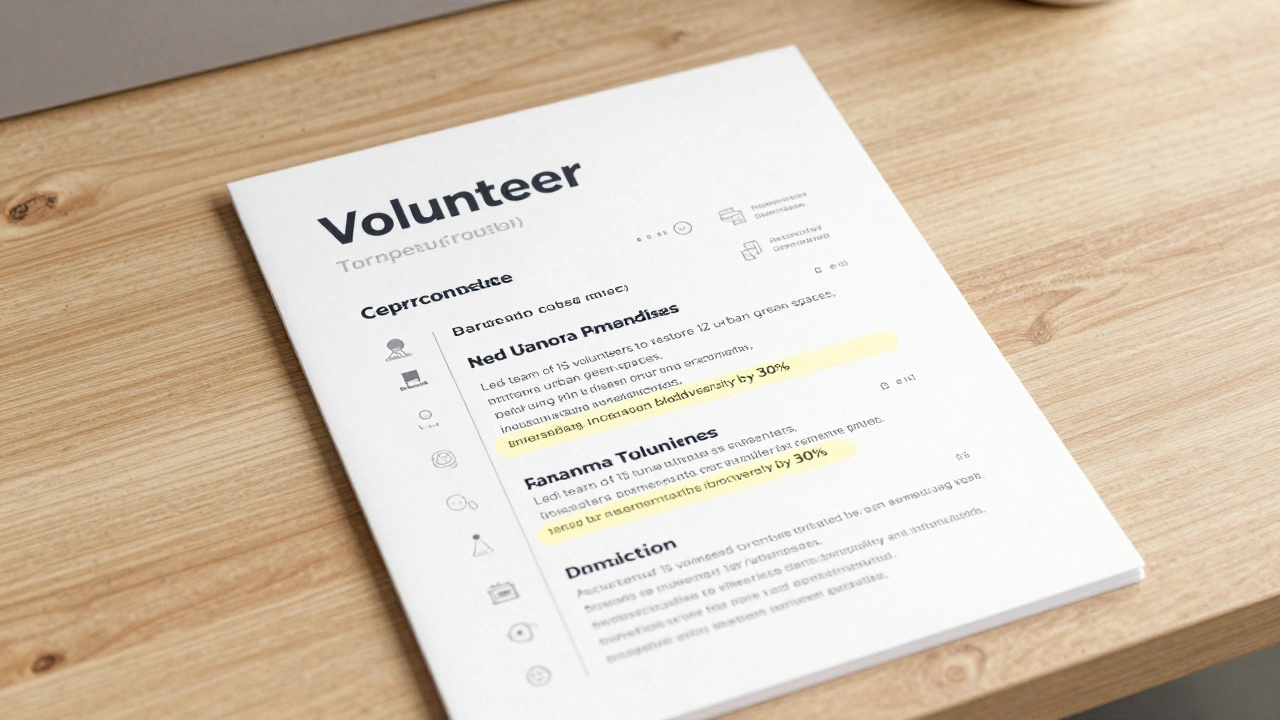
Volunteer Project Manager
Green Earth Initiative | Jan 2023 - Present
- Led a team of 15 volunteers to restore 12 urban green spaces, increasing local biodiversity by 30%
- Secured $8,000 in grants through donor outreach and proposal writing
- Reduced operational costs by 22% by implementing a digital scheduling system
Notice how every bullet point includes a verb, a scope, and a result. That’s the formula.
What Volunteering Says About You (That Interviews Can’t Always Reveal)
Employers don’t just hire skills. They hire people they trust. Volunteering signals a few quiet but powerful traits:
- Work ethic - You showed up without being paid. That says you’re self-motivated.
- Empathy - You chose to serve people or causes outside your own benefit.
- Adaptability - Nonprofits rarely have perfect tools or budgets. You learned to work with less.
- Community-mindedness - Especially important in companies that value culture, CSR, or local impact.
A 2024 LinkedIn survey found that 78% of hiring managers were more likely to interview candidates who listed volunteer experience - even if the role wasn’t directly related. Why? Because it reduces risk. Someone who gives their time freely is less likely to quit suddenly or act selfishly.

Common Mistakes to Avoid
Not all volunteer listings help. Here’s what kills the effect:
- Being vague - “Helped out at a food bank” tells them nothing.
- Overloading - Listing 10 short-term gigs makes you look scattered.
- Using emotional language - “I love helping others” sounds nice, but it’s not professional.
- Only doing it for your resume - Interviewers can tell if you’re faking passion. Pick causes you care about.
Volunteering isn’t a resume hack. It’s a reflection of who you are. If you’re not genuinely invested, it shows. But if you are - it becomes one of your strongest talking points.
Real Example: From Volunteer to Hired
Jamal applied for a customer service role at a tech startup. He had no prior customer service experience - just a year of volunteering at a nonprofit call center helping seniors with Medicare applications.
On his resume, he wrote:
Volunteer Call Center Representative
Senior Support Network | Mar 2023 - Dec 2024
- Handled 20+ daily calls from elderly clients, resolving complex benefit issues with 96% satisfaction rating
- Created a step-by-step guide for new volunteers that cut training time by 40%
- Trained 8 new volunteers in de-escalation techniques and HIPAA-compliant communication
He got the job. The hiring manager said: “He handled more real-world customer issues in one year than most applicants had in five years of retail.”
Final Thought: It’s Not Just About Getting Hired
Volunteering doesn’t just look good on paper. It changes you. You learn patience. You solve problems with limited resources. You build relationships across generations and backgrounds. Those aren’t just resume bullets - they’re life skills.
And in a job market where so many candidates look the same on paper, the ones who’ve done something meaningful stand out. Not because they volunteered. But because they showed up, stayed consistent, and made a difference - even when no one was watching.
Does volunteering count as work experience?
Yes - if you describe it like work experience. Employers care about what you did, not whether you got paid. Use action verbs, quantify results, and frame it the same way you would a paid job. For example: “Managed a team of 10 volunteers” or “Increased donation rates by 35%.” If it shows skills relevant to the job, it counts.
How long should I volunteer before it helps my resume?
Three to six months is the minimum to show consistency. One-day events don’t build credibility. But if you’ve volunteered for 8 months or more, especially in a leadership or recurring role, it becomes a strong asset. The key isn’t length - it’s depth. Two years of part-time work at a nonprofit can outweigh six months of full-time work if the responsibilities are meaningful.
Should I list volunteering on my LinkedIn profile?
Absolutely. LinkedIn’s algorithm favors profiles with diverse experiences. Use the “Volunteer Experience” section to add roles just like jobs. Include the same details: title, organization, dates, and bullet points. Many recruiters search for keywords like “volunteer leadership” or “fundraising.” Not listing it means you’re leaving opportunities on the table.
Can volunteering help if I’m changing careers?
It’s one of the best tools you have. If you’re moving from hospitality to tech, volunteering to help a nonprofit build a website or manage their email campaigns gives you hands-on experience. It’s proof you can learn and apply new skills. Employers will trust you more if you’ve already tested the waters - even as a volunteer.
What if I don’t have time to volunteer?
Start small. One hour a week for 3 months is better than nothing. You can also offer pro bono skills - like editing a nonprofit’s newsletter, helping with their website, or designing flyers. Even micro-volunteering adds up. The goal isn’t to burn out - it’s to show initiative. Consistency beats intensity.