
Volunteer Impact Calculator
Calculate Your Professional Value
Your Professional Value
Total Volunteer Hours:
Equivalent Paid Work:
Resume Achievement Example:
Tip: Add specific numbers like "22%" or "£8,000" to show measurable impact.
People often think volunteering is something you do in your free time-on weekends, after work, or during holidays. But what if you could turn that same passion for helping others into a full-time job? It’s not a fantasy. Thousands of people have built real careers out of volunteering. Not by accident. Not by luck. But by making smart, intentional moves. If you’ve ever felt that your volunteer work meant more to you than any paid job ever did, you’re not alone. And you’re not wrong to want more from it.
Volunteering isn’t just charity-it’s experience
Think about what you actually do when you volunteer. You organize events. You manage teams. You raise money. You train people. You solve problems with limited resources. These aren’t side activities. These are professional skills. A volunteer who runs a weekly food distribution program is managing logistics, inventory, staff, and community relations-all without a paycheck. That’s not a hobby. That’s project management. That’s operations. That’s leadership.
Nonprofit organizations don’t always have big HR departments. They rely on volunteers to fill roles that would otherwise need paid staff. So if you’ve been helping out at a local shelter, a community garden, or a youth mentoring program, you’ve already been doing the work of a professional. The question isn’t whether you’re qualified-it’s whether you’ve documented it.
Start treating your volunteer work like a resume
You wouldn’t leave your paid job without a list of accomplishments. Why do it with volunteering? Start keeping track. Write down:
- What you did (e.g., “Led weekly tutoring sessions for 15 at-risk teens”)
- How long you did it (e.g., “Volunteered 10 hours per week for 18 months”)
- What you achieved (e.g., “Improved average test scores by 22% over one academic year”)
- What tools or systems you used (e.g., “Managed donor database using Salesforce Nonprofit Cloud”)
This isn’t just for your resume. It’s for your LinkedIn profile. It’s for grant applications. It’s for interviews. Many nonprofit hiring managers don’t expect volunteers to have formal work experience-but they do expect you to speak like a professional. If you can show measurable impact, you’re already ahead of half the applicants.
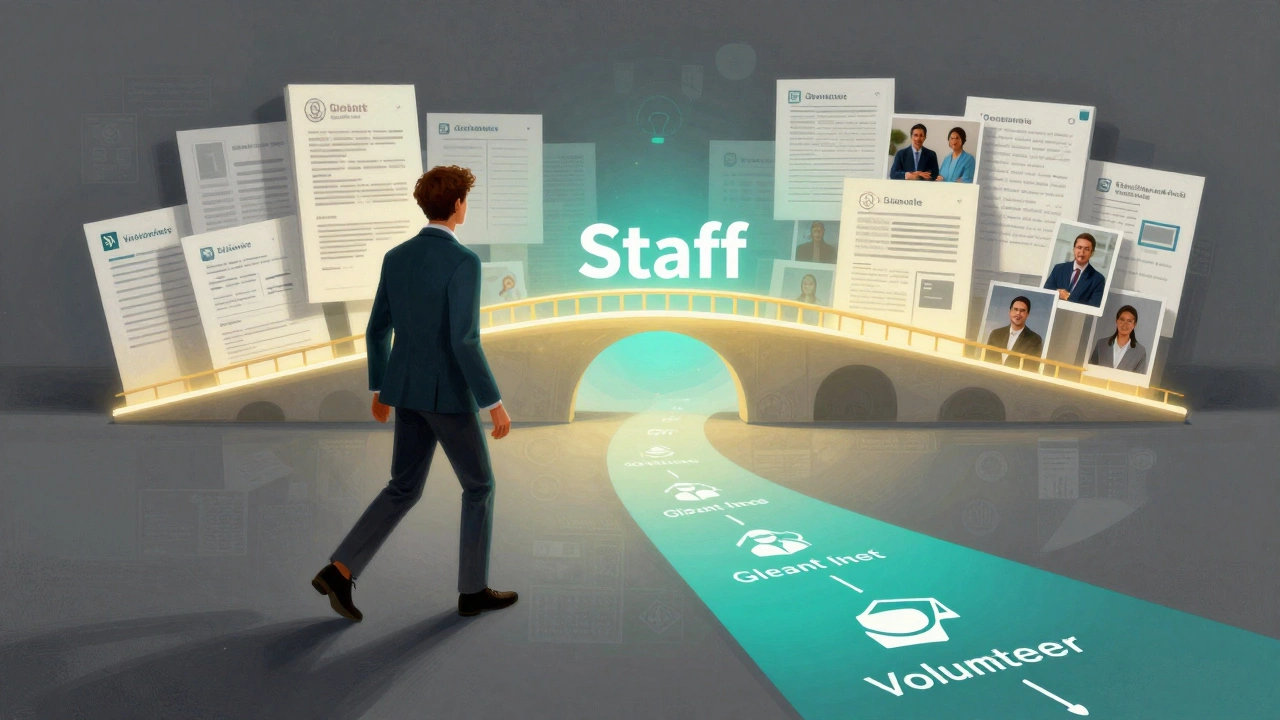
Transition from volunteer to staff
The most direct path to a paid role? Start where you already are. Nonprofits hire from within more often than you think. If you’ve been volunteering at an organization for more than six months, you’re not just a helper-you’re a known quantity. You know their culture. You know their challenges. You’ve earned trust.
Here’s how to make the leap:
- Ask for feedback. Say: “I’m thinking about applying for a paid role here. What skills should I focus on developing?”
- Take on more responsibility. Volunteer for tasks that are close to paid positions-budget tracking, event planning, grant writing, training new volunteers.
- Express interest. Don’t wait for them to notice. Say: “I’m really passionate about this work and would love to explore how I could contribute full-time.”
- Apply internally first. Many nonprofits post job openings only to staff before opening them to the public.
One woman in Edinburgh started by helping at a local animal shelter. She handled adoption paperwork, coordinated vet appointments, and trained new volunteers. After 14 months, she applied for the shelter’s new Animal Welfare Coordinator role-and got it. She didn’t have a degree in animal science. She had experience.

Learn the language of nonprofits
Nonprofits don’t run like corporations. They live on grants, donations, and limited budgets. To move into a paid role, you need to understand how they survive. Learn these terms:
- Grant writing - Applying for money from foundations or government programs
- Donor management - Building relationships with people who give money
- Impact reporting - Showing donors and funders what your work actually achieved
- Board governance - How volunteer boards oversee nonprofit operations
Many community colleges and online platforms offer free or low-cost courses in nonprofit management. Look for programs from Charity Commission for Scotland the official regulator of charities in Scotland, which provides guidance and training resources for nonprofit professionals. Or check out Volunteer Scotland a national organization that supports volunteer development and connects volunteers with training opportunities. These aren’t just nice-to-have-they’re essential tools for career growth.
Build a portfolio, not just a CV
Forget the old-school resume. In the nonprofit world, a portfolio works better. Create a simple website or Google Doc that includes:
- Photos of events you organized (with permission)
- Testimonials from staff or people you helped
- Examples of reports or newsletters you wrote
- Numbers: “Raised £8,000 in 3 months,” “Recruited 40 new volunteers,” “Reduced food waste by 30%”
This shows more than your job history. It shows your impact. And impact is what nonprofits care about most.
Target roles that value volunteer experience
Not all nonprofit jobs are the same. Some roles are perfect for people coming from volunteering:
- Community Outreach Coordinator - You talk to people, build trust, organize events. If you’ve done door-to-door canvassing or neighborhood meetings, you’re already qualified.
- Program Assistant - You support daily operations. If you’ve managed schedules, tracked supplies, or handled phone calls for a charity, this is your next step.
- Volunteer Manager - Yes, this is a paid job. And it’s often filled by someone who’s volunteered first. You’re the bridge between the organization and its volunteers.
- Grant Writer - If you’ve ever written a simple funding request for your volunteer group, you’ve done the basics. Now learn the advanced skills.
These roles don’t always require degrees. They require proven ability. And you’ve already proven it.
Network like a professional
Volunteer networks are powerful. Go to local nonprofit mixers. Attend workshops. Join Scottish Council for Voluntary Organisations (SCVO) the national membership organization for Scotland’s voluntary sector, offering training, networking, and job boards. Don’t just show up-ask questions. Say: “I’ve been volunteering for three years and want to move into a paid role. What’s the best path for someone like me?”
Most people in the sector will help you. They’ve been there. They remember the first time they went from volunteer to staff. They’ll point you to job boards, introduce you to hiring managers, or even tell you when a position is about to open.
Don’t wait for the perfect role
Many people think they need to land a “dream job” right away. That’s a trap. Start with any paid role in the nonprofit world-even if it’s part-time or entry-level. A £12/hour coordinator job at a food bank is still a career step. It’s experience. It’s a reference. It’s a foot in the door.
One man in Glasgow started as a weekend volunteer at a homelessness charity. He took a part-time role as a night shift support worker. Two years later, he became the program manager. He didn’t wait for perfection. He kept showing up.
It’s not about giving up your passion-it’s about turning it into your livelihood
Volunteering isn’t a stepping stone to something else. It’s the thing itself. The people who make careers out of it aren’t selling out. They’re doubling down. They’re saying: “This work matters. I want to do it full-time. And I’m going to get paid to do it well.”
The nonprofit sector needs more people like you. People who care deeply. People who’ve already proven they can deliver. You don’t need a fancy degree. You don’t need to wait for permission. You just need to start treating your volunteer work like the professional experience it already is.
Can you really get paid for volunteering?
Yes. Many nonprofits hire volunteers into paid roles, especially if they’ve shown reliability, leadership, and impact. Some organizations even offer stipends or expense coverage while you volunteer, which can lead to full-time positions. The key is to treat your volunteer work like a job-document your contributions, build skills, and express interest in paid opportunities.
Do I need a degree to work in nonprofits?
Not necessarily. While some roles-like social work or counseling-require formal qualifications, many positions in program coordination, volunteer management, and community outreach value experience over degrees. Employers look for proven ability: Can you manage a budget? Can you lead a team? Can you write a grant? These are skills you can build through volunteering.
What’s the best way to find nonprofit jobs?
Start with local job boards like Volunteer Scotland and SCVO. Check the websites of charities you already volunteer with-they often post openings internally first. LinkedIn is also powerful: use filters like "nonprofit" and "volunteer experience" in your search. Don’t ignore small organizations-they hire more frequently and have less competition.
How do I talk about volunteering on a resume?
List it like a job. Use the same format: position title, organization, dates, and bullet points showing responsibilities and achievements. Instead of "Volunteered at food bank," write: "Managed weekly food distribution for 200+ families, coordinated 12 volunteers, and increased efficiency by 25% through new inventory tracking system." Quantify everything you can.
Is paid volunteering the same as a real job?
Yes-if it comes with regular hours, responsibilities, and compensation. Some programs offer stipends or housing in exchange for service (like AmeriCorps or Peace Corps). These are structured roles with clear expectations, not just free labor. They count as real work experience and often lead to full-time employment in the sector.