
Fundraising Goal Calculator
Enter your fundraising target and estimated average donation to see how many people you need to ask, broken down by donor tier.
0
Total Donors Needed
0
Est. Weeks (at 5 asks/day)
Recommended Donor Breakdown
Family & Close Friends (High conversion rate)
Colleagues & Social Media (Medium conversion)
Local Businesses & Strangers (Low conversion)
Raising $5,000 sounds like a lot until you break it down. It’s not one giant check from a millionaire; it’s fifty people giving $100, or ten people giving $500. The hardest part isn’t the math-it’s the momentum. Most campaigns stall because organizers try to do too much at once. You don’t need a viral TikTok moment or a celebrity endorsement. You need a clear plan, a specific ask, and the guts to actually talk to people.
This guide skips the fluff. We’re looking at real-world tactics that work in small communities and online spaces alike. Whether you are supporting a local food bank in Edinburgh or a global health initiative, the mechanics of hitting that five-figure target remain surprisingly consistent. Let’s get your campaign moving.
The Quick Summary
- Break it down: $5,000 is 50 donors at $100 each. Focus on volume over big checks initially.
- Pick one channel: Don’t spread yourself thin. Choose either a physical event, an online challenge, or direct outreach.
- Use matching gifts: Find one sponsor who will match donations up to $1,000 to double early impact.
- Tell a story: People give to emotions, not spreadsheets. Share one specific beneficiary’s story.
- Ask personally: Direct messages convert 3x better than social media posts alone.
Define Your Ask and Audience
Before you post anything, you need clarity. Vague goals kill donations. "Help us save the whales" is weak. "Help us fund two new rescue nets for the Scottish coast by December" is strong. Specificity creates urgency.
The core entity here is Peer-to-Peer Fundraising, defined as a method where individuals raise funds for a nonprofit through their personal networks. This approach leverages trust. When your friend asks for help, you listen. When a corporation sends a generic email, you delete it.
You need to identify who actually cares about your cause. If you are raising money for youth programs, your primary audience might be parents and local businesses, not college students. Map out three tiers of potential donors:
- Inner Circle: Family and close friends. They will likely give regardless of the pitch. Aim for 10-15 donations here.
- Extended Network: Colleagues, acquaintances, social media followers. They need a reason to care. Aim for 20-30 donations.
- Cold Contacts: Local businesses or online strangers. These are harder wins but necessary for scaling. Aim for 5-10 donations.
Strategy 1: The Micro-Event Approach
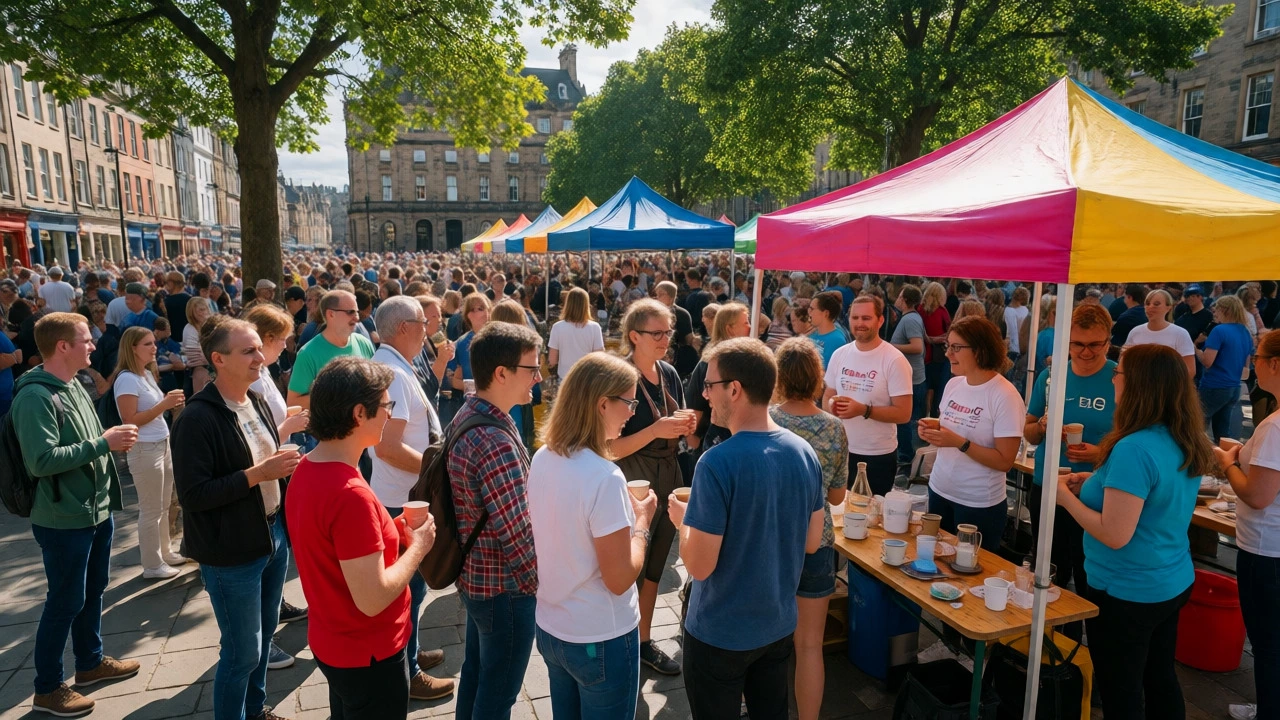
You don’t need a gala dinner costing $10,000 to raise $5,000. In fact, big events often eat into profits. Try a micro-event instead. Think low overhead, high engagement.
Consider a "Penny Drive" or a themed bake sale, but with a twist. Instead of just selling cookies, sell experiences. A local barista might donate coffee beans; you sell "coffee tastings" for $10. Ten cups sold equals $100. Do this at a busy weekend market, and you can hit $500 in a day. Multiply that by five weekends, and you are halfway there.
Another option is a fitness challenge. A "Run for Relief" where participants solicit pledges per mile is classic for a reason. It works because it combines health goals with charitable giving. If you recruit 20 runners and they average $150 each, you’ve hit your goal. The key is providing them with easy tools-pre-written social media posts, QR codes for payment, and regular updates so they feel supported.
Strategy 2: Corporate Matching and Sponsorships
Many organizations have budgets for community support that go unclaimed. Walk into local businesses with a simple proposal. Don’t ask for money immediately. Ask for visibility.
Offer to put their logo on your t-shirts, flyers, or website banner. In exchange, ask for a flat sponsorship fee of $250-$500. If you secure four sponsors, that’s $1,000-$2,000 right off the top. This reduces the burden on individual donors and makes your campaign look more credible.
| Method | Time Investment | Cost to Organize | Average Return | Best For |
|---|---|---|---|---|
| Online Crowdfunding | Low (Setup) / High (Promo) | Minimal ($0-$50) | $2,000 - $4,000 | Digital-savvy audiences |
| Local Event (Bake Sale/Car Wash) | High (Logistics) | Moderate ($100-$200) | $500 - $1,500 per event | Community-focused causes |
| Corporate Sponsorship | Medium (Sales Pitching) | Low (Printing materials) | $250 - $500 per sponsor | Businesses wanting brand exposure |
| Direct Outreach (Email/Call) | High (Personal effort) | Zero | $50 - $200 per donor | Strong existing networks |
Strategy 3: The Power of Direct Outreach
Here is a statistic that surprises most fundraisers: face-to-face or voice-to-voice requests are significantly more effective than digital ones. A study by the Mutt Foundation suggests that personal appeals yield higher conversion rates because they trigger reciprocity.
Make a list of 50 people you know well. Send them a personalized message-not a copy-paste blast. Say something like, "Hey Sarah, I’m helping [Charity Name] buy new equipment for kids with disabilities. I’m trying to raise $5,000. Would you be open to donating $25? It really helps."
If you get 20 yeses at $25, that’s $500. Now ask those same people if they know someone else who might want to give. Referrals are gold. One happy donor can bring in three more. Keep a spreadsheet. Track who gave, how much, and when. Follow up with a thank-you note within 48 hours. Personal notes cost less than a stamp but build long-term relationships.

Building Momentum with Storytelling
Data doesn’t move wallets; stories do. You need a hero. Who benefits from this $5,000? Create a character. If you are raising money for homeless support, don’t say "we help the homeless." Tell the story of John, who slept under the bridge last winter and now has a warm bed thanks to previous donors.
Use visuals. A photo of John smiling beats a pie chart every time. Update your donors regularly. If you hit $1,000, tell them. "We are 20% there! Thanks to you, we can buy the first set of blankets." This gamifies the process. People want to be part of a winning team.
Transparency builds trust. Show exactly where the money goes. Breakdowns like "$500 for rent," "$300 for food," and "$200 for admin costs" reassure donors that their money isn’t vanishing into black holes. In Scotland, charities registered with OSCR (Office of the Scottish Charity Regulator) must adhere to strict reporting standards, which adds a layer of credibility you should highlight.
Common Pitfalls to Avoid
Most failed campaigns make the same mistakes. First, they start too late. Raising $5,000 takes weeks, not days. Start six weeks before your deadline. Second, they forget to ask. People are busy. They aren’t ignoring you; they just forgot. Gentle reminders are okay.
Third, they lack a call to action (CTA). Don’t just share news. Ask for action. "Donate now," "Share this post," "Sign up for the run." Ambiguity leads to inaction. Finally, don’t ignore small donations. A $5 donation from a student is still a win. It builds a habit of giving. Celebrate every contribution publicly (with permission).
Next Steps and Troubleshooting
You have the strategies. Now execute. Pick one method that fits your personality and network. If you hate public speaking, skip the gala. If you love social media, lean into crowdfunding platforms like GoFundMe or JustGiving.
If you stall at $2,000, change tactics. Add a matching gift deadline. "Double your impact if you donate by Friday." Urgency drives action. If you stall at $4,000, reach out to your biggest supporters individually. Ask them to stretch their pledge slightly or introduce you to their boss.
Raising $5,000 is entirely achievable. It requires consistency, not perfection. Start today. Make the first ask. Then make the second. Before you know it, you’ll be crossing that finish line.
What is the fastest way to raise $5,000?
The fastest method is usually a combination of corporate sponsorships and a high-engagement online challenge. Securing 4-5 local business sponsors at $500 each provides immediate capital, while a peer-to-peer campaign engages your wider network simultaneously.
Do I need a tax-exempt status to fundraise?
Not necessarily. If you are an individual raising money for a registered charity, you can often use platforms like GoFundMe which handle the transfer. However, for large sums, partnering directly with a registered nonprofit ensures donors receive tax receipts, which encourages larger donations.
How many donors do I need for $5,000?
It depends on the average donation size. At $50 per donor, you need 100 people. At $100 per donor, you need 50 people. Focusing on acquiring 50 mid-level donors is often easier than finding 5 major donors or 500 small donors.
Should I hire a professional fundraiser?
For a $5,000 goal, probably not. Professional fees often exceed the budget. Use free tools like Canva for graphics, Mailchimp for emails, and standard payment processors. Save professional help for goals above $50,000.
What if I miss my deadline?
Don’t panic. Extend the timeline transparently. Explain why you need more time and what progress has been made. Often, a slight extension with a renewed push can gather the final 10-20% needed to complete the goal.