
Virtual Volunteering Impact & Risk Assessor
Project Compatibility Checker
Quick Takeaways
- Digital barriers can lead to social isolation and burnout.
- Lack of physical presence limits the impact of emotional support.
- Technology gaps create inequality in who can participate.
- Managing remote teams requires more effort than in-person oversight.
- Security and data privacy risks increase when working via the cloud.
The Human Gap: Why Screens Can't Replace Handshakes
One of the biggest hits you take with virtual volunteering is the loss of genuine human connection. Virtual volunteering is the practice of providing services to a non-profit or community project via the internet and digital tools. When you're physically present, you pick up on tiny cues-a sigh, a hesitant look, or the energy of a room. These things are almost impossible to catch over a laggy video call.
Think about a mentor working with a struggling teenager. In a physical setting, the mentor can see if the student is distracted or upset just by their posture. Online, the student might turn off their camera, and the mentor is left guessing. This creates a "sterile" environment where the emotional weight of the work is diluted. You aren't just losing a commute; you're losing the subtle, non-verbal communication that builds deep trust. For many, this makes the experience feel like a corporate job rather than a heartfelt act of service.
The Digital Divide and Accessibility Barriers
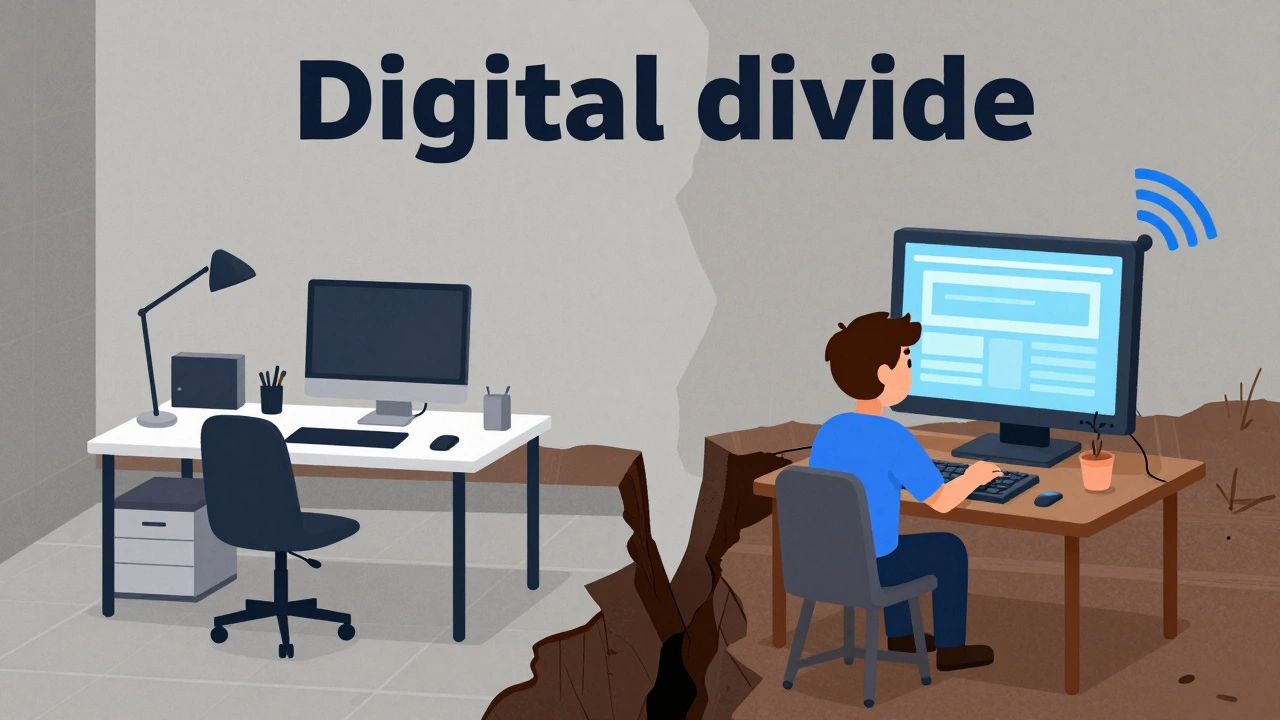
We often assume everyone has a high-speed connection and a modern laptop, but that's a huge mistake. Digital Poverty is a real issue. When an organization moves its operations online, they might unintentionally shut out the very people they are trying to help. If a charity provides literacy support via a paid software platform, families who can't afford a monthly subscription or a stable 5G connection are left behind.
It isn't just the recipients who suffer. Many passionate volunteers-especially older generations who might have a lifetime of expertise-struggle with the technical side of things. If a non-profit requires a specific Content Management System (CMS) or a complex project management tool like Trello or Asana, a great volunteer might quit simply because they can't figure out the login process. This narrows the pool of volunteers to only those who are tech-savvy, which means you lose out on diverse perspectives and seasoned experience.
The Mental Toll: Isolation and 'Zoom Fatigue'
There's a weird paradox with remote work: you're connected to the world, but you've never felt more alone. In a traditional volunteer setting, you're part of a team. You chat during breaks, you share a laugh over a shared struggle, and you feel a sense of camaraderie. With virtual volunteering, your "teammates" are just squares on a screen.
This leads to a specific kind of burnout. We've all felt it-that mental exhaustion after four hours of consecutive video meetings. When your volunteering happens in the same chair where you work your 9-to-5, the boundaries between your personal life, your job, and your service disappear. You don't have the physical transition of leaving a building to signal that your "work" is done. Over time, this can make the act of giving back feel like another chore on a checklist rather than a rewarding break from the grind.
The Management Nightmare: Oversight and Accountability
For the organizations running these programs, managing a remote fleet of volunteers is a logistical headache. In a physical office, a manager can walk over to someone's desk and ask, "How's that report coming along?" In a virtual environment, that same check-in can feel like micromanagement or a cold, impersonal email.
| Feature | In-Person Volunteering | Virtual Volunteering |
|---|---|---|
| Training | Hands-on, immediate feedback | Recorded videos, manuals, asynchronous |
| Accountability | Visual presence, easy check-ins | Relies on software logs and reports |
| Culture | Organic, social bonding | Intentional, scheduled "social" calls |
| Onboarding | Guided tour, face-to-face intro | Email chains and digital portals |
Accountability also becomes a bit of a gamble. It is much easier for a virtual volunteer to ghost a project than it is for someone to stop showing up to a physical location where they are known. When a volunteer vanishes from a Slack channel, the project stalls, and the organization may not realize it for days. This lack of immediate visibility can lead to missed deadlines and a breakdown in the quality of the service provided.
Security Risks and Data Privacy Concerns
When you move a charity's operations to the cloud, you open the door to Cybersecurity risks. Many non-profits operate on shoestring budgets and don't have the money for enterprise-grade security. When volunteers access sensitive donor lists or client information from their personal home computers, they are creating a massive vulnerability.
Imagine a volunteer using a public Wi-Fi network at a cafe to update a database of refugees or domestic violence survivors. If that connection isn't secure, the data is at risk. Unlike a controlled office environment where the hardware is managed by the organization, virtual volunteering relies on the volunteer's own security habits. A single weak password or an outdated antivirus program can lead to a data breach that could jeopardize the safety of the people the organization is trying to protect.

The Quality Control Struggle
Finally, there's the issue of output quality. When a volunteer is on-site, a supervisor can provide real-time course correction. If a volunteer is misinterpreting a policy while talking to a client, the supervisor can step in immediately. In the virtual world, that mistake might happen in a private chat or an email, and the organization won't find out until the damage is already done.
This is especially true for skilled volunteering, like pro-bono legal advice or accounting. If the communication isn't crystal clear, the resulting work might not meet the organization's standards. The "distance" in virtual volunteering isn't just about miles; it's about a gap in shared understanding. Without the ability to quickly huddle and align on a goal, projects often drift off course, requiring more time to fix later than they would have taken to do correctly the first time.
Is virtual volunteering less impactful than in-person work?
Not necessarily, but the impact is different. While you can't provide physical comfort or hands-on labor, you can provide specialized skills-like web design or grant writing-that a local volunteer might not have. The impact is often higher in terms of "deliverables" but lower in terms of "human connection."
How can I prevent burnout while volunteering online?
Set a strict schedule. Create a physical boundary, like a specific desk or room, where you only do your volunteering. When you're done, shut down the computer and move to a different space to help your brain switch from "service mode" back to "home mode."
What are the biggest security risks for remote volunteers?
The primary risks are phishing attacks, the use of unsecured public Wi-Fi, and the storage of sensitive data on personal devices. Using a VPN and a password manager is highly recommended for anyone handling non-profit data remotely.
Can virtual volunteering actually help my career?
Yes, it's a great way to build a portfolio of work and demonstrate your ability to collaborate in a remote environment-a skill highly valued by modern employers. It allows you to gain experience with international organizations that you wouldn't otherwise be able to reach.
How do organizations bridge the gap in remote volunteer culture?
Many use "virtual watercoolers" or dedicated social channels in Slack/Discord where volunteers can talk about non-work topics. Some also organize occasional in-person meetups or hybrid events to put faces to the names on the screen.
Moving Forward: Finding the Balance
If you're feeling the strain of a digital-only experience, consider a hybrid approach. If your organization allows it, suggest a monthly in-person gathering or a "phone-call-only" day to break the monotony of video screens. For organizations, the key is to stop treating virtual volunteers like a cheaper version of in-person staff and instead build a dedicated digital culture that accounts for isolation and technical barriers.
Ultimately, the goal is to make sure the technology serves the mission, not the other way around. Whether you're fighting climate change through a spreadsheet or tutoring a student via Skype, remember that the tool is just a means to an end. If the tool is getting in the way of the actual help, it's time to change the process.