Ecological Community Comparison Tool
Explore how different ecological communities function through interactive comparison. Select any community type to see key characteristics and real-world examples from the article.
Key Takeaways
Ecological communities are dynamic networks where species interact through predation, competition, parasitism, mutualism, and commensalism. All communities require habitat connectivity to thrive, and urban areas can support meaningful ecological communities with proper management. Each community type has unique characteristics shaped by climate, soil, geography, and disturbances.
When you walk through a forest, a wetland, or even a city park, you’re not just seeing trees, birds, and bugs. You’re stepping into a living network where every organism plays a part. This network isn’t random. It’s organized, interdependent, and constantly changing. Scientists have a name for it: an ecological community.
What Exactly Is an Ecological Community?
An ecological community is a group of different species that live in the same place and interact with each other. It’s not just about what’s there-it’s about how they all connect. Think of it like a neighborhood, but instead of people, you’ve got fungi, insects, plants, mammals, and microorganisms all sharing the same space.
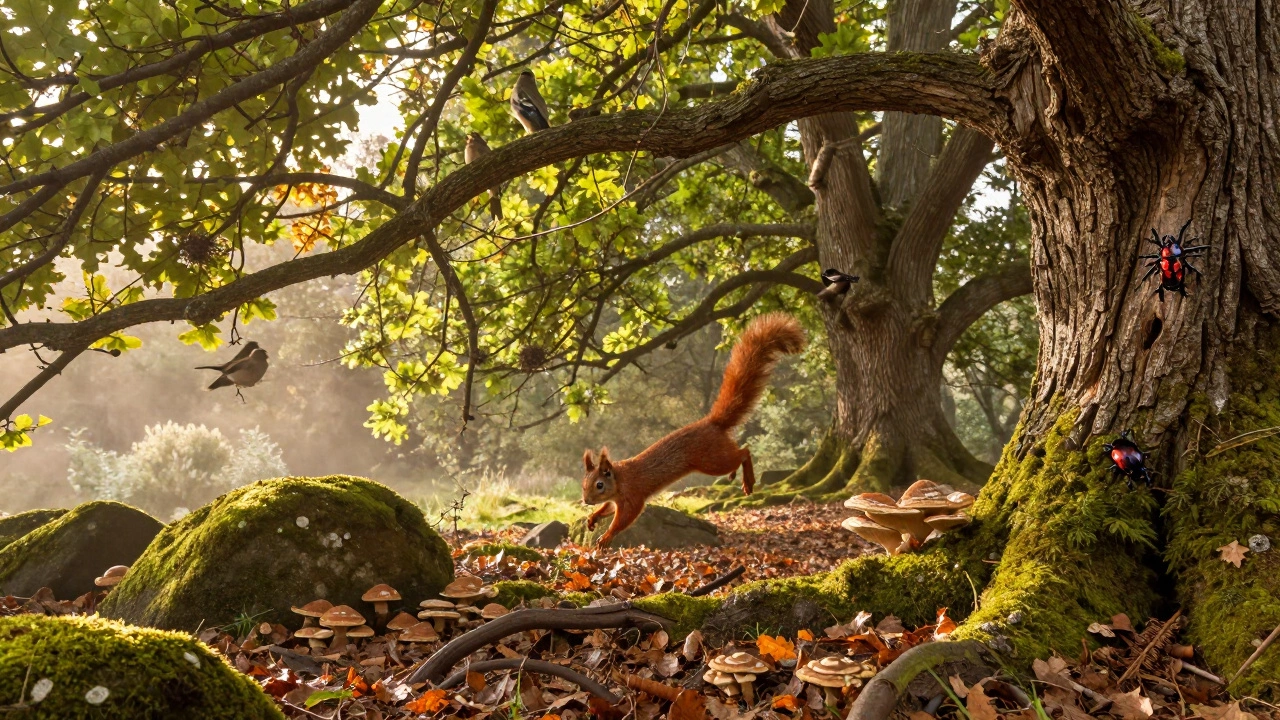
For example, in a Scottish woodland near Edinburgh, you might find oak trees, red squirrels, fungi breaking down fallen leaves, beetles feeding on bark, and birds nesting in the canopy. None of these species survive alone. The squirrels eat acorns from the oaks. The fungi help the trees absorb nutrients. The beetles provide food for birds. The birds spread seeds. It’s a web of give-and-take.
This is different from an ecosystem. An ecosystem includes the community plus the non-living parts-soil, water, sunlight, air, and climate. The ecological community is just the living players.
Why Do Species Group Together?
Not every species can live everywhere. They need the right conditions. A polar bear won’t survive in a desert. A cactus won’t grow in a bog. So species end up clustered where the environment suits them. That’s how ecological communities form.
They’re shaped by:
- Climate-temperature, rainfall, seasons
- Soil type-nutrient levels, drainage, pH
- Geography-mountains, rivers, coastlines
- Disturbances-fires, floods, human activity
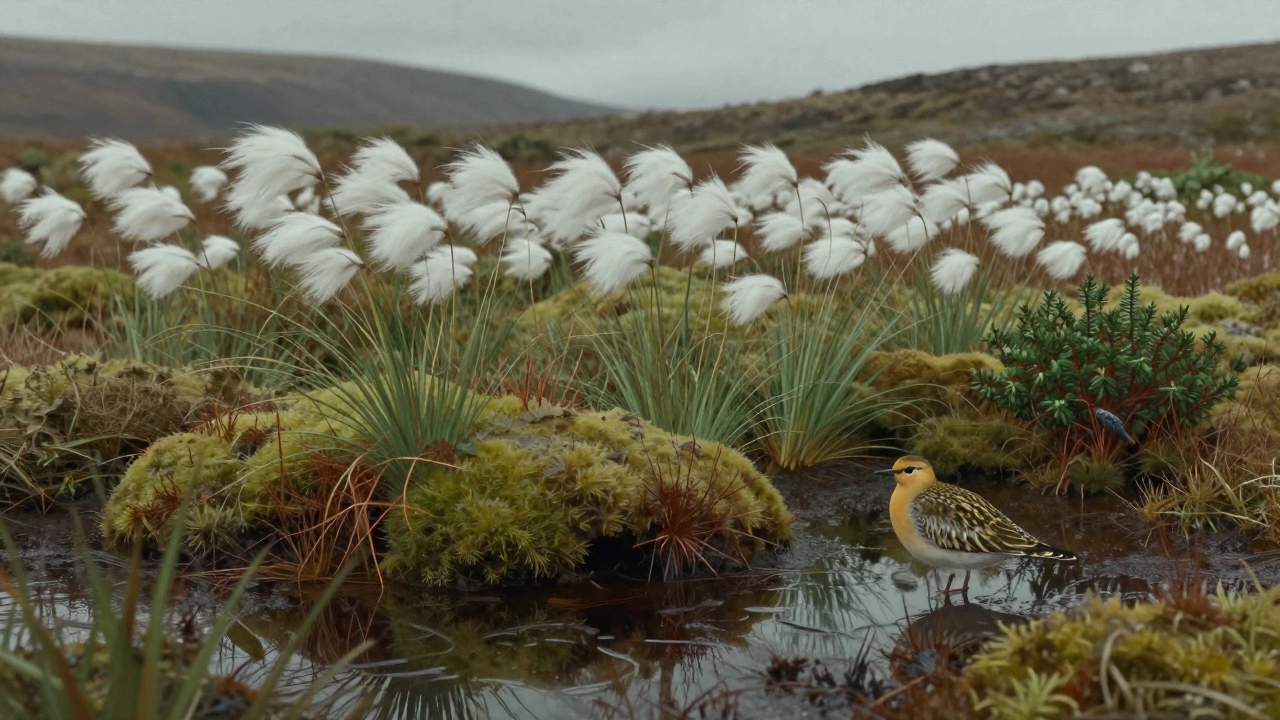
Take the peat bogs of the Scottish Highlands. The cold, wet, acidic conditions mean only certain plants can grow-like sphagnum moss, cotton grass, and bog myrtle. Those plants then attract specific insects, birds like the golden plover, and rare amphibians. Together, they form a unique ecological community found nowhere else on Earth.
Types of Ecological Communities
Ecological communities aren’t all the same. They vary wildly depending on where you are. Here are a few common types:
- Forest communities-dense with trees, layered with understory plants, fungi, and animals from insects to deer.
- Grassland communities-dominated by grasses, with burrowing mammals, grazing herbivores, and birds of prey.
- Aquatic communities-in lakes, rivers, or oceans, with algae, fish, crustaceans, and microbes.
- Desert communities-sparse vegetation, but surprisingly rich in adapted species like reptiles, nocturnal mammals, and hardy succulents.
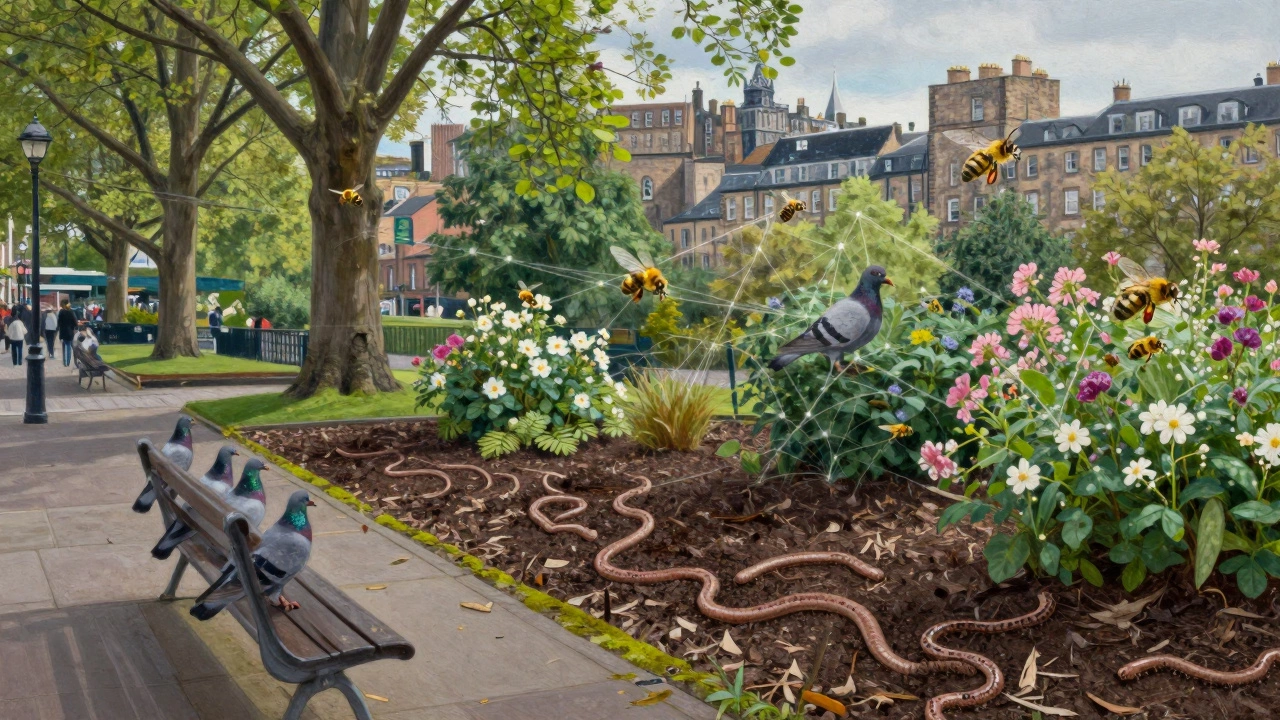
- Urban communities-often overlooked, but cities have their own mix: pigeons, rats, street trees, garden insects, and even fungi growing on pavement cracks.
Each one has its own balance. Some are stable for centuries. Others shift quickly after a fire or a storm.
How Do Species Interact?
Within a community, species don’t just coexist-they influence each other. These relationships fall into a few key patterns:
- Predation-one species hunts another. A fox eating a rabbit.
- Competition-two species fight over the same resource. Two bird species both eating the same type of seed.
- Parasitism-one benefits, the other is harmed. A tick feeding on a deer’s blood.
- Mutualism-both benefit. Bees pollinating flowers while collecting nectar.
- Commensalism-one benefits, the other isn’t affected. A bird building a nest in a tree.
These interactions keep the community in motion. If one species disappears, others feel the ripple. In Scotland, the reintroduction of lynx in some areas is being studied because they might control deer populations. Too many deer, and they overgraze young trees. Fewer trees mean fewer birds, fewer insects, and less soil stability. It’s all connected.
How Scientists Study These Communities
Researchers don’t just guess. They count. They track. They sample. In a forest, they might:
- Set up quadrats-square frames on the ground-to count plant species.
- Use camera traps to record which animals pass through.
- Collect soil samples to see which microbes are present.
- Monitor bird calls over seasons to track migration patterns.
They also use DNA from environmental samples-like water or soil-to detect species that are hard to see. This is called eDNA (environmental DNA). It’s how scientists found rare amphibians in Scottish lochs without ever spotting them.
Long-term monitoring is key. In the Cairngorms, scientists have tracked a single mountain stream community for over 20 years. They’ve seen how warming temperatures push cold-water fish like the Atlantic salmon farther uphill-and how the insects they feed on are shifting too.
Why Do Ecological Communities Matter?
They’re not just interesting. They’re essential.
Healthy communities clean our water, store carbon, pollinate crops, and prevent floods. A wetland community, for instance, acts like a natural sponge. It soaks up rainwater, filters out pollutants, and slowly releases water into rivers-reducing flood risk downstream.
When communities break down, we feel it. The collapse of bee populations affects food crops. The loss of coral reefs destroys fish habitats. The decline of pollinators in urban gardens means fewer berries, fruits, and flowers.
In Scotland, the loss of ancient woodlands has reduced the number of lichen-dependent insects. Some of those insects only live in one type of tree. When the tree vanishes, so do they-and the birds that eat them.
What Threatens Ecological Communities?
Not all changes are natural. Human activity is the biggest disruptor:
- Habitat destruction-clearing land for farming, roads, or housing.
- Invasive species-non-native plants or animals that outcompete locals. In Scotland, Japanese knotweed chokes out native riverbank plants.
- Climate change-shifting temperatures force species to move, but not all can. Some get trapped.
- Pollution-chemical runoff kills aquatic life. Light pollution disrupts nocturnal species.
- Overharvesting-fishing, hunting, or collecting too many species too fast.
These pressures don’t act alone. They stack up. A forest might be fragmented by roads, then invaded by pests, then warmed by climate change. The community doesn’t have time to adapt.
Can We Restore Them?
Yes-but it’s hard. And it takes time.
Restoration isn’t just planting trees. It’s rebuilding relationships. In the Highlands, conservation groups are reconnecting isolated woodlands by planting hedgerows and creating wildlife corridors. They’re removing invasive species and reintroducing native ones, like the European beaver.
Beavers? Yes. Their dams create wetlands. Those wetlands attract dragonflies, frogs, water voles, and otters. Suddenly, a single species has helped rebuild an entire community.
Community involvement matters too. Citizen scientists in Edinburgh now record bird sightings, monitor pond life, and track invasive plants. Their data helps researchers spot changes early.
Final Thought: It’s All Connected
An ecological community isn’t just a scientific term. It’s a reminder that life doesn’t exist in isolation. Every creature, plant, and microbe has a role. Lose one, and the whole system trembles. Protect one, and you might be saving dozens more.
The next time you see a patch of moss on a tree, or hear a robin sing in a city garden, remember-you’re witnessing a living network older than any human city. And it’s still working.
Is an ecological community the same as an ecosystem?
No. An ecological community includes only the living organisms in a given area-plants, animals, fungi, microbes. An ecosystem includes those living things plus the non-living parts of the environment, like soil, water, air, sunlight, and climate. So every ecological community is part of an ecosystem, but not every ecosystem is just a community.
Can urban areas have ecological communities?
Absolutely. Cities have their own communities. Think of a park with trees, earthworms in the soil, pigeons, sparrows, bees pollinating flowers, and fungi decomposing leaves. Even cracks in sidewalks can host moss and lichen. Urban communities are often simpler than wild ones, but they’re still complex, dynamic, and vital for local biodiversity.
What’s the most important factor in maintaining an ecological community?
Habitat connectivity. Species need space to move, find food, mate, and escape threats. When habitats are broken up by roads, farms, or buildings, populations become isolated. This leads to inbreeding, disease spread, and local extinction. Maintaining or restoring corridors-like hedgerows, green roofs, or riverbanks-helps communities stay healthy.
How do scientists identify which species belong to a community?
They use field surveys, camera traps, sound recordings, and environmental DNA (eDNA). eDNA is especially powerful: by testing soil or water samples for traces of genetic material, scientists can detect species without seeing them. For example, they’ve found rare otters in Scottish rivers just from water samples.
Can a single species be part of multiple ecological communities?
Yes. Many species move between habitats. A red squirrel, for instance, lives in coniferous forests, but may travel to nearby orchards for food. A salmon spends part of its life in freshwater streams and part in the ocean. These species link different communities, helping transfer energy and nutrients across landscapes.